KelVPN
 About
About 9 min
9 minDo You Need a VPN for Online Education? Security, Access, and Privacy
Online education has become an integral part of our lives. Schoolchildren and students study remotely, teachers conduct webinars and consultations, and self-education through global platforms (Coursera, Udemy, Khan Academy) is now the norm. But one question arises: do you need a VPN for online classes? And if so, what problems does it solve and what should you pay attention to?
In this article, we explore why students, teachers, and anyone engaged in online learning might need a VPN, what threats it mitigates, and how to choose a reliable service for safe and uninterrupted education.
Access to Global Educational Resources

Some platforms restrict content based on geography. A VPN lets you access full materials from anywhere in the world.
Protection on Public Networks
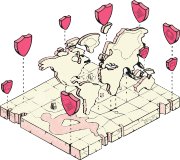
Students and teachers often connect from cafés, coworking spaces, or libraries. A VPN encrypts traffic and safeguards passwords, messages, and personal files.
Bypass Throttling for Stable Connections

Some ISPs throttle video conferencing speeds. A VPN hides traffic type and helps maintain call quality.
Privacy and Protection from Tracking
Educational platforms and ISPs may collect your activity data. A zero-logs VPN preserves your anonymity.
Part 1. Key Challenges in Online Education
Before discussing VPNs, it’s essential to understand the difficulties participants face in the digital learning environment.
- Geographic restrictions: Many platforms (Coursera, edX, YouTube educational channels) may block access to certain courses or materials based on your location. Even within the same platform, content can differ by region.
- Unsecured networks: Students and teachers often work outside home — in cafés, libraries, university campuses with open Wi-Fi. On such networks, attackers can easily intercept passwords, private messages, and files.
- Throttling (speed limitation): ISPs may intentionally slow down video conferencing (Zoom, Google Meet, Microsoft Teams) or streaming, making classes uncomfortable.
- Content blocking and censorship: In some regions, access to educational resources may be restricted at the state level. A VPN helps access knowledge while respecting local legislation.
- Data collection and privacy violations: Educational platforms and even ISPs may collect activity data that is later used for targeting or sold to third parties.
Part 2. How a VPN Solves These Problems
A VPN is not just an IP-changing tool; it’s a comprehensive security solution for online learning.
2.1. Access to Global Educational Resources
By connecting to a server in another country, you obtain that country’s IP address. This allows you to access materials restricted in your region. For example, some courses on platforms are only available to users from specific countries. With a VPN, you can “move” to the required location and gain full access.
2.2. Traffic Encryption on Public Networks
On public Wi-Fi networks, a VPN creates an encrypted tunnel between your device and the internet. Even if an attacker intercepts packets, they see only gibberish, not your passwords, assignments, or communication with teachers.
2.3. Counteracting Throttling
When an ISP detects you using Zoom or YouTube, it may artificially reduce speed. A VPN hides the type of traffic, so the ISP cannot differentiate and throttle it. As a result, video calls become more stable and materials load faster.
2.4. Bypassing Blocks and Censorship
In some countries, governments may block educational websites, academic journals, or even YouTube. A VPN provides unrestricted access to these resources, provided you comply with local laws.
2.5. Privacy Protection
Quality VPN services, such as KelVPN, maintain a strict no-logs policy. They do not store records of your connections, visited sites, or actions. Your learning stays your own business.
Part 3. Do You Specifically Need a VPN? Use Cases
Let’s look at concrete scenarios where a VPN becomes essential.
| Scenario | VPN Needed? | Why? |
|---|---|---|
| You study from home on a secure home Wi-Fi | Optional | Home networks are usually protected, but a VPN adds extra privacy and helps bypass any ISP restrictions. |
| You frequently study in cafés, libraries, coworking spaces | Highly recommended | Public Wi-Fi is unsafe. A VPN is the only way to ensure your passwords and data are not intercepted. |
| You use international platforms (Coursera, edX, Udemy) | Advisable | Some courses may be unavailable in your country. A VPN expands access to educational content. |
| Your ISP frequently throttles video calls | Recommended | A VPN bypasses throttling and makes classes more comfortable. |
| You live in a country with internet censorship | Critical | A VPN provides access to blocked educational resources. |
| You care about privacy and don’t want platforms collecting your data | Recommended | A zero-logs VPN hides your activity from educational platforms and ISPs. |
Part 4. What to Look for in a VPN for Online Classes
When choosing a VPN for education, pay attention to these features:
- Speed and stability: For video conferences and streaming lectures, high speed is critical. Decentralized VPNs (like KelVPN) distribute load and ensure stable connections.
- Server locations: The more countries available, the easier it is to access regional content.
- No-logs policy: Choose services that do not store your activity data — this guarantees your privacy.
- Modern protocols: The KelVPN protocol balances speed and security.
- Cross-platform support: You may learn from a laptop, tablet, or smartphone. Ensure the VPN works on all your devices.
- Kill Switch: A feature that cuts off internet if the VPN disconnects, preventing data leaks — especially useful when handling sensitive information.
Part 5. Why KelVPN Is an Ideal Choice for Education
KelVPN is built with the needs of modern users, including students and teachers, in mind.
- Decentralized node network: Load is distributed, guaranteeing high speed and stability even during peak hours.
- Quantum-resistant encryption: Your data is protected not only today but also against future quantum computer threats.
- Strict zero-logs policy: We do not store information about your connections, visited sites, or actions. Your learning remains confidential.
- Wide server geography: Access content from different countries for comprehensive self-education.
- Support for all platforms: Windows, macOS, Linux, Android, and even Raspberry Pi.
- Built-in Kill Switch: Protection against leaks during connection drops.
Part 6. How to Use a VPN for Classes: Step-by-Step
Step 1. Download KelVPN
Install the app on the device you use for learning (laptop, tablet, smartphone).
Step 2. Choose a Server

For maximum speed, pick the nearest server. To access regional content, select the corresponding country.
Step 3. Connect

Click “Connect” and wait for the connection to establish. Your traffic is now protected.
Step 4. Start Your Class

Open Zoom, Google Meet, educational platforms — everything works securely and reliably.
Part 7. Legality of Using a VPN for Education
In most countries, using a VPN is completely legal. It is a legitimate tool for data protection and access to information. However, some nations may impose restrictions on using VPNs to bypass national blocks. Before using a VPN, familiarise yourself with local laws.
Our position: KelVPN is designed to protect privacy and security, not to break the law. We encourage responsible use of our service within the legal framework.
Part 8. Frequently Asked Questions
Glossary
- VPN (Virtual Private Network): technology that creates an encrypted tunnel between your device and the internet, hiding your real IP.
- Throttling: intentional speed reduction by an ISP for certain types of traffic.
- Kill Switch: a feature that automatically cuts off internet when the VPN disconnects.
- Zero-logs: a policy where the service stores no data about your activity.
- Decentralized VPN: a VPN built on a network of independent nodes, improving resilience and speed.
- Quantum-resistant encryption: algorithms resistant to attacks by quantum computers.
Conclusion
Online education unlocks endless opportunities, but it demands attention to security and content accessibility. A VPN for online classes is not just a trendy accessory — it is an essential tool that protects your data, ensures stable connections, and expands access to knowledge worldwide. Choose a reliable service like KelVPN and make your learning comfortable and secure.