Quantum-Secure and Decentralized VPN with Canada Servers: Privacy, Speed, and Access in 2026
What is a VPN with Canada Servers and Why Do You Need It?
In 2026, as the internet has become an integral part of life, access to local digital services and the protection of personal data are paramount. A VPN with servers in Canada from KelVPN is your secure gateway to the Canadian segment of the internet, allowing you to stay connected to your favorite services no matter where you are.
Canada has a rich digital ecosystem: popular streaming platforms like CBC Gem, Crave, CTV, Global TV, advanced banking apps (RBC, TD, Scotiabank, BMO, CIBC), and numerous local news outlets. However, outside the country, access to these services is often blocked due to geo-restrictions. Even inside Canada, using public Wi-Fi in Toronto or Vancouver cafés can be unsafe, and ISPs sometimes throttle speeds for streaming video.
KelVPN solves all these challenges. We offer not just an IP address change, but comprehensive protection for your digital life using quantum-resistant technologies.
Access to Canadian Content

Watch CBC Gem shows, Crave exclusives, CTV and Global News from anywhere. Get a Canadian IP and enjoy your favourite programs as if you were at home.
Maximum Privacy
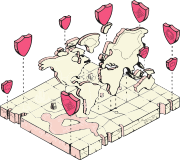
Your browsing history, correspondence, and banking transactions remain confidential. KelVPN ensures your data is inaccessible to ISPs, advertisers, and third parties.
Quantum-Resistant Security

We use CRYSTALS-Dilithium and Kyber 512 algorithms, certified by NIST. Your data is protected not only today but also against future quantum computer attacks.
Fast Servers Across Canada

Decentralized nodes located throughout Canada ensure high speed and stability. Stream HD video without buffering and make video calls without delays.
Decentralized VPN: An Innovative Approach to Security in Canada
Traditional VPN services use centralized servers, creating a single point of failure and privacy risks. KelVPN is a decentralized VPN built on a network of independent nodes operated by ordinary people around the world, including many nodes in Canada.
This architecture eliminates the possibility of a central server being eavesdropped on or blocked, making the connection not only more secure but also resilient to failures. Your traffic passes through several nodes, guaranteeing anonymity and protection from surveillance.
How to Start Using KelVPN for a Canadian IP?
Just four simple steps and you are online with a Canadian IP.
Step 1. Download the App
Download KelVPN for Windows, macOS, Linux, Android, or Raspberry Pi.
Step 2. Install
Install the app following the on-screen instructions.
Step 3. Buy a Key
Purchase an access key: we accept cryptocurrency and bank cards.
Step 4. Connect to Canada

Choose "Canada" from the country list and click "Connect".
The Access Challenge: Why You Need a VPN for Canadian Services
Many Canadian online platforms restrict access based on geography. For example, CBC Gem allows viewing only from Canadian IPs, Crave blocks foreign connections, and banking apps may refuse login from abroad. Even inside the country, ISPs sometimes throttle speeds for streaming video.
How KelVPN Solves These Issues:
- Canadian IP Address: By connecting to our server, you obtain a local IP, and services see you as a user from Canada.
- Traffic Encryption: The VPN tunnel hides your activity from your ISP, preventing throttling.
- Public Wi-Fi Security: In cafés, hotels, and airports, encryption protects your passwords and data from interception.
Paid vs. Free VPNs: Why KelVPN is the Right Choice
Free VPNs often make money by selling user data or displaying intrusive ads. They do not provide adequate security and can be blocked by streaming platforms.
| Criteria | Free VPNs | KelVPN (Paid) |
|---|---|---|
| Data Collection | Collect and sell logs, IPs, browsing history. | Strict zero-logs policy. We do not know your activity. |
| Encryption | Weak or outdated (vulnerable). | Quantum-resistant (CRYSTALS-Dilithium, Kyber 512). |
| Speed | Severely limited, overloaded servers. | High speed, decentralized nodes. |
| Access to Canadian Services | IPs often blacklisted by CBC Gem, Crave. | Stable access, regularly refreshed IPs. |
| Ads | Intrusive, sometimes malicious. | Completely ad-free. |
Can You Rely on a Free VPN for Canadian Content?
Technically yes, but with great risks. Free providers are often based in lax-privacy jurisdictions and may sell your data. Moreover, their small IP pools are quickly blacklisted. With KelVPN you get a reliable, fast, and private connection with no compromises.
VPN for Travellers and Expats: Stay Connected to Canada
For Canadians abroad and foreigners accustomed to local services, KelVPN is an indispensable companion.
- Watch Canadian TV: CBC Gem, Crave, CTV, Global TV — all your favourite shows available from anywhere.
- Use Banking Apps: Log in to RBC, TD, Scotiabank, BMO, CIBC without risk of being blocked.
- Listen to Radio: CBC Radio One, Radio-Canada, local stations without geo-restrictions.
- Read News: CBC News, The Globe and Mail, Toronto Star — always up-to-date information, just like at home.
Important: Using a VPN to access content you are subscribed to is permitted by law (Canada has no specific restrictions against VPNs).
Legality of Using a VPN with Canada Servers
In Canada, using a VPN is completely legal. It is a tool for privacy protection, secure remote access, and combating unfair throttling. Canadian law does not prohibit using a VPN to access geographically restricted content, as long as it does not violate copyright.
However, KelVPN strongly asks you to respect copyright laws and study the current legislation of the country where you reside or are visiting. Using a VPN for illegal activities (e.g., hacking or accessing pirated content) is prohibited. We are not responsible for users violating local regulations.
Our Position: KelVPN is intended for data protection and lawful access to information, not for unlawful acts.
Who We Are: About the KelVPN Project
KelVPN is part of the Cellframe Network ecosystem, focused on building quantum-secure services using blockchain. The project has its own KEL token, traded on UniSwap and PancakeSwap. Token holders can stake and even become VPN providers, earning income by sharing their traffic. Technical requirements are minimal: a stable internet connection, a public IP, and a small amount of staked KEL.
The History of VPN: From ARPANET to Quantum Protection
1960s
ARPANET — the predecessor of the internet, laying the foundations of TCP/IP.
1993
Development of swIPe — the first protocol resembling modern VPNs.
1996
PPTP from Microsoft — the first mass-market VPN protocol.
Today
KelVPN combines decentralization and quantum resistance.
In-Depth Technical Analysis: What is a Decentralized VPN?
Unlike centralized solutions where all data passes through a single server, dVPN uses a network of nodes. This provides:
- Fault tolerance: failure of one node does not affect the network.
- Speed: traffic is distributed, avoiding congestion.
- Anonymity: no central hub storing logs.
KelVPN is built on blockchain, ensuring transparency and immutable network rules.
How to Get a Canadian IP Address with KelVPN?
- Download and install KelVPN.
- Buy an access key (crypto or card).
- Select "Canada" from the server list.
- Click "Connect".
Done! Your IP is now Canadian and all traffic is encrypted.
Platforms and Devices: KelVPN Where You Need Protection
Download VPN for Your Platform
KelVPN for PC
KelVPN for Mobile
Other Platforms
Technical Support
Having installation issues? Contact our support team.
FAQ: Answers to Popular Questions
Glossary: Key Terms
- VPN: encrypted tunnel technology.
- IP address: device identifier on the network.
- Decentralized VPN: VPN without a central server.
- Node: a point in the dVPN network.
- Quantum-resistant encryption: algorithms immune to quantum attacks.
- Zero-logs: no storage of logs.
- Kill Switch: automatic internet cutoff if VPN drops.
- Geoblocking: access restriction by country.
- Throttling: intentional slowdown by ISP.
- P2P: direct device-to-device data exchange.
- MITM attack: interception of data between user and server.
- DNS leak: situation where DNS requests escape the VPN tunnel.