VPN for Google Maps: Secure Navigation & Route Protection
Google Maps is a leading platform for navigation and mapping, offering real-time routes, Street View, and location-sharing features. Accessible via web browsers (Chrome, Firefox, Safari, Edge), iOS, Android, Windows, macOS, and Linux, it serves travelers, drivers, and businesses with intuitive tools. Unstable networks or privacy risks can disrupt map access, while unsecured connections may expose location data. A secure solution like KelVPN ensures fast, encrypted, and reliable access for seamless navigation. Try KelVPN now to enhance your mapping experience.
What is Google Maps?
Google Maps, launched in 2005, is a global navigation and mapping platform providing detailed maps, real-time navigation, traffic updates, and features like Street View and location sharing. Accessible through web browsers (Chrome, Firefox, Safari, Edge), iOS, Android, Windows, macOS, and Linux, it caters to travelers, drivers, tourists, and businesses. Its free core features, combined with premium tools like APIs for developers, make it indispensable for route planning and location exploration.
Key functionalities include real-time navigation for cars, pedestrians, and public transit, 3D Street View, and nearby place searches. Users can save locations, share routes, and access offline maps for travel without internet. Safety features, such as safe route alerts, enhance trust. The platform’s mobile apps and web interface ensure flexibility across devices, while integrations with Google Assistant and smart devices expand its reach.
Google Maps serves billions of users globally, offering localized maps and multilingual support, including English. It integrates with Google services like Google My Business for business promotion and provides APIs for embedding maps in apps. Data security and stable connections are critical, especially on public networks where risks are high, making tools like KelVPN valuable for protecting location data and ensuring uninterrupted access.
The platform supports educational and social initiatives by providing maps for research and events. Features like Street View and panoramas attract tourists, while integrations with smartwatches and car systems enhance usability. Google Maps is more than a navigation tool—it’s a comprehensive platform for exploring the world and planning journeys with precision.
Globally, Google Maps connects users with accurate maps and location data, supporting multiple platforms and integrations for versatility. Its role in travel, logistics, and business makes it a cornerstone of modern navigation. Connectivity and security challenges in public or restricted networks highlight the need for reliable solutions to protect data and maintain access during navigation.
Why is Google Maps So Popular?
Google Maps’ popularity stems from its accurate maps, real-time navigation, and universal accessibility. Its support for web browsers, iOS, Android, Windows, macOS, and Linux ensures broad reach. Free access to core features like routes and Street View, paired with premium APIs, attracts a diverse user base. Its global map database, covering millions of locations, solidifies its leadership. Despite potential network restrictions in corporate or public Wi-Fi, its intuitive interface and integrations drive widespread adoption.
Here’s why Google Maps stands out:
- Accurate Navigation: Real-time routes for cars, pedestrians, and transit, with live traffic updates, simplify travel planning.
- Street View and Exploration: 3D street-level imagery allows virtual exploration of cities and landmarks.
- Localized Support: Maps and multilingual interfaces, including English, cater to global users.
- Integrations: Seamless connections with Google Assistant, smartwatches, and car systems enhance usability.
- Business Tools: Google My Business helps companies promote locations, boosting visibility.
- Offline Access: Offline maps support navigation in low-connectivity areas, ideal for travelers.
Google Maps’ role in travel and business fuels its popularity. Businesses leverage Google My Business for promotion, while APIs enable developers to integrate maps into apps. Offline maps and real-time updates make it essential for travelers. Connectivity issues in public or corporate networks underscore the need for secure, stable connections to maintain navigation reliability.
The platform’s global reach spans continents, with localized maps and community support. Its scalability suits individual users and enterprises alike. Regular updates, including AI-driven route optimization, keep Google Maps competitive. Its blend of accuracy, functionality, and accessibility makes it a go-to tool for navigation and exploration.
Google Maps continues to attract users with its intuitive design and robust integrations. Used in logistics, tourism, and daily life, it offers solutions for all scenarios. Network challenges in restricted environments highlight the value of solutions like KelVPN for uninterrupted access. Google Maps’ ability to deliver precise navigation and connect users globally cements its leadership in mapping.
History of Google Maps
Google Maps was launched in February 2005 by Google as a web-based mapping service. Initially focused on basic maps, it expanded with Street View in 2007 and real-time navigation in 2008. By 2025, it serves billions of users across web browsers, iOS, Android, Windows, macOS, and Linux. Key milestones include offline maps in 2011 and AI-driven route enhancements in 2020.
Google Maps evolved to meet user needs:
- 2007: Street View introduced, enabling virtual exploration.
- 2008: Real-time navigation added for drivers and pedestrians.
- 2012: Mobile apps for iOS and Android launched for on-the-go access.
- 2013: Updated web interface improved usability.
- 2020: AI algorithms enhanced traffic predictions and route recommendations.
Key developments include the API launch in 2006, Google My Business in 2009, and location sharing in 2017. Google Maps integrated with Google Assistant and smart devices, expanding functionality. Investments in AI and machine learning personalized routes, while global coverage and localized maps boosted adoption. Connectivity challenges in public or corporate networks emphasize the need for tools like KelVPN for stable access.
Google Maps adapted to modern trends, introducing eco-friendly routes in 2021 and AR navigation in 2022. It supports businesses with analytics via Google My Business and collaborates with regulators to comply with data laws. Its global reach, with maps in over 220 countries, ensures accessibility. The platform’s focus on innovation drives its growth.
As of October 14, 2025, Google Maps plans deeper AI integrations and smart device compatibility. Its support for travelers, businesses, and developers ensures versatility. The history of Google Maps underscores its role as a leading navigation and mapping platform, with data security and connectivity remaining critical for users worldwide.
Google Maps Growth in Numbers
Google Maps boasts remarkable growth, serving over 1 billion monthly active users by 2025. It covers more than 220 countries and territories, mapping millions of locations. Daily, users perform billions of route searches and Street View explorations. Support for web browsers, iOS, Android, Windows, macOS, and Linux drives adoption. Network restrictions in public or corporate Wi-Fi highlight the need for stable connections.
Key metrics include:
- Billions of API Requests: Monthly API calls power millions of apps.
- Millions of Business Profiles: Google My Business profiles drive visibility.
- Billions of Traffic Updates: Real-time data supports drivers globally.
- Millions of Offline Downloads: Offline maps aid travelers in low-connectivity areas.
- 80% Retention Rate: Intuitive design keeps users engaged.
Google Maps’ global reach spans North America, Europe, Asia, and beyond, with localized maps and English support. Businesses benefit from millions of profile views, while APIs support apps in logistics and tourism. The platform hosts millions of events, like virtual tours. Connectivity and security challenges in diverse environments emphasize the need for reliable solutions like KelVPN.
Google Maps continues to expand with features like eco-friendly routes and AR navigation. Investments in AI improve recommendations and traffic predictions. Billions rely on Google Maps for daily navigation. Its metrics showcase its dominance in mapping and navigation, with stable access remaining critical for users.
Why Use a VPN for Google Maps?
A secure connection enhances your Google Maps experience by ensuring privacy, stability, and data protection. Here are the key benefits of using a solution like KelVPN:
Secure Navigation in Google Maps Without Restrictions

Some ISPs throttle speeds, causing delays in map loading or route updates. A secure connection masks traffic, preventing throttling and ensuring fast access to maps. KelVPN optimizes routes for seamless navigation.
Maximum Data Protection for Google Maps
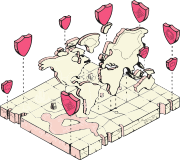
Unsecured networks can expose location data or search queries. An encrypted tunnel protects routes and searches. KelVPN uses advanced encryption for secure access across devices.
Google Maps Access on All Devices

Google Maps supports web browsers, iOS, Android, Windows, macOS, and Linux. A secure connection ensures stability on Windows, macOS, Linux, and Android. KelVPN guarantees smooth access across your devices.
Secure Google Maps Access on Public Wi-Fi

Using Google Maps in cafes or airports can risk data exposure. An encrypted connection safeguards routes and queries. KelVPN ensures secure access on public networks.
Reliable Connection for Google Maps Access

Unstable networks can disrupt map loading or navigation. Optimized traffic routes ensure stability. KelVPN supports uninterrupted Google Maps access.
Privacy for Google Maps Usage

Your routes and search queries should remain private. A secure connection prevents tracking of navigation activity. KelVPN’s zero-logs policy ensures complete privacy.
Key Benefits of Using a VPN for Google Maps
- Location Data Protection: Encryption safeguards routes and queries from interception.
- Reduced Lag: KelVPN’s low-latency servers ensure fast map loading.
- Stable Navigation: Reliable connections support seamless map usage.
- Device Security: KelVPN protects access on PCs, Android, or Linux, preventing leaks.
- Privacy Without Logs: KelVPN does not store data about your navigation activities.
- Secure API Integrations: KelVPN protects interactions with Google Maps’ API and third-party apps.
| Benefit | Description | How KelVPN Helps |
|---|---|---|
| Secure Navigation | Prevents throttling for fast map access. | KelVPN masks traffic, eliminating delays for smooth navigation. |
| Data Protection | Encrypts routes and queries. | KelVPN uses advanced encryption to secure map data. |
| Device Compatibility | Ensures stable access on all supported devices. | KelVPN supports Windows, macOS, Linux, and Android for seamless access. |
| Wi-Fi Security | Protects data on public networks. | KelVPN encrypts connections for safe navigation in cafes or airports. |
| Reliable Connection | Eliminates disruptions from unstable networks. | KelVPN optimizes routes for uninterrupted map access. |
| Privacy | Keeps navigation activities private. | KelVPN’s zero-logs policy prevents tracking of map interactions. |
*Using a VPN, like KelVPN, must comply with local laws and Google Maps’ terms of service.
Download VPN for Your Platform
KelVPN for PC
KelVPN for Mobile
Other Platforms
Technical Support
Having installation issues? Contact our support team
How KelVPN Connects You to Google Maps
1. Encrypt your data
2. Hide your IP
3. Browse safely & privately
Install a secure solution like KelVPN to navigate Google Maps safely and reliably. KelVPN supports Windows, macOS, Linux, and Android but does not offer iOS apps or browser extensions, ensuring compatibility with Google Maps’ platforms. Get started with KelVPN for secure navigation.
Advantages of KelVPN for Google Maps: Secure and Stable Navigation
Ironclad Data Protection for Google Maps
Public Wi-Fi networks can expose location data or queries. KelVPN uses military-grade encryption to safeguard routes and searches during navigation.
Universal Device Compatibility for Google Maps
Google Maps is accessible via web browsers, iOS, Android, Windows, macOS, and Linux. KelVPN ensures secure connections on Windows, macOS, Linux, and Android for seamless access.
Complete Privacy with Zero-Logs Policy
Your navigation activities are private. KelVPN’s zero-logs policy ensures no data about your map interactions is stored.
Intuitive Interface for Google Maps Access
A secure connection should simplify access. KelVPN’s intuitive interface enables quick connections for seamless navigation and map usage.
Decentralized Network for Google Maps Security
Centralized servers are vulnerable. KelVPN’s decentralized network protects map data from attacks, ensuring reliable access.
Quantum-Safe Data Protection for Google Maps
Quantum technologies may threaten encryption. KelVPN uses quantum-resistant algorithms to protect your navigation data long-term.
How KelVPN Enhances Google Maps Use Cases
- Secure Navigation: KelVPN protects routes, queries, and API interactions with encryption.
- Stable Platform Access: Navigation and map loading require stability. KelVPN ensures low latency for smooth usage.
- Device Security: KelVPN safeguards access on PCs, Android, or Linux, preventing data leaks.
- Multi-Device Access: KelVPN supports simultaneous use across multiple devices.
- Secure Integrations: KelVPN protects interactions with Google Maps’ API and third-party apps.
*Using a VPN, like KelVPN, for illegal purposes is prohibited and violates our Terms of Service. Ensure usage complies with local laws and Google Maps’ terms.
Legality of Using a VPN for Google Maps

Using a secure connection with Google Maps is legal in most jurisdictions, provided it complies with local laws, regulations, and Google Maps’ terms of service. Solutions like KelVPN are commonly used to enhance data security and stabilize connections. Some users may employ these tools to access Google Maps in restricted networks, such as corporate or public Wi-Fi. To ensure compliance, review local laws, regulations, and Google Maps’ terms before using a secure connection.
Google Maps’ Stance on VPNs
Google Maps permits secure connections for improving security and stability, provided they adhere to its terms of service and applicable laws. Always ensure your usage aligns with these guidelines to avoid potential violations.
Data Protection on Public Networks
Accessing Google Maps on public Wi-Fi, such as in cafes or airports, can expose location data to risks. KelVPN encrypts your connection, preventing unauthorized access and ensuring secure navigation.
Compliance with Terms of Service
Google Maps encourages secure and reliable navigation. Using a secure connection to protect data or stabilize access aligns with these goals, provided it complies with legal and service requirements.
Best Practices for Responsible VPN Use
- Avoid using it for illegal activities.
- Prioritize data protection and connection stability.
- Verify compliance with local laws and regulations.
- Adhere to Google Maps’ terms of service for secure usage.
Conclusion
Using a secure connection with Google Maps is legal and effective for enhancing security and stability, provided it respects local laws, regulations, and Google Maps’ terms. KelVPN offers robust protection for secure navigation. Learn more about KelVPN pricing.